
What is multiple disadvantage?
People facing multiple disadvantage experience a combination of problems. For many, their current circumstances are shaped by long-term experiences of poverty, deprivation, trauma, abuse and neglect. Many also face racism, sexism and homophobia. These structural inequalities intersect in different ways, manifesting in a combination of experiences including homelessness, substance misuse, domestic violence, contact with the criminal justice system and mental ill health.
Multiple disadvantage is a systemic, not an individual issue. People facing multiple disadvantage live in every area of the country. They are often failed by services and systems that focus on singular issues. This makes it harder for individuals to address their problems, lead fulfilling lives and contribute fully to their communities.
Why does it matter?
This status quo remains unacceptable. Evidence has shown that better coordinated interventions from statutory and voluntary agencies can improve people’s lives and reduce the use and cost of crisis services. Many local areas are now making progress on better support for people facing multiple disadvantage and the long-term sustainable changes to local systems that make this possible, but it is not yet happening across the country.
MEAM is working to ensure that every area of the country has a strong partnership approach to multiple disadvantage in place and is taking practical steps to transform services and local systems for people facing multiple disadvantage.
How many people experience multiple disadvantage?
The research report Hard Edges, published in 2015, estimated that 58,000 people face problems of homelessness, substance misuse and offending in any one year. Within this group, a majority will have experienced mental health problems. Women are under-represented in these figures, but despite this face significant and distinct challenges which need to be met. Similarly, people from black, Asian and minority ethnic communities experience a range of social inequalities which contribute to their experience of multiple disadvantage.
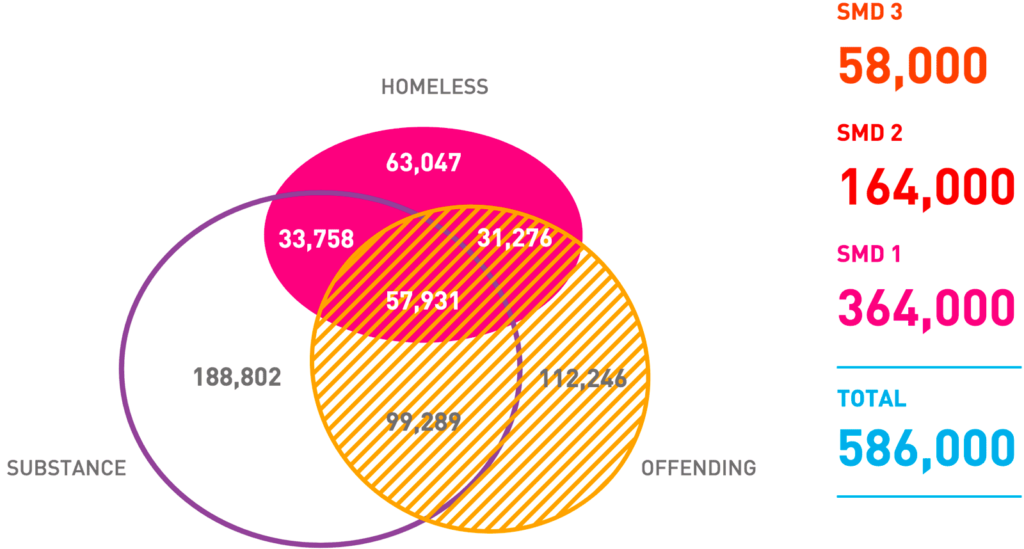
Hard Edges: Mapping Severe and Multiple Disadvantage in England (Lankelly Chase, 2015)
Gender Matters
Following Hard Edges, the same research team began a process to explore how disadvantages might cluster differently in the lives of women. The report Gender Matters, published in 2020, included interpersonal violence and abuse and poor mental health as primary domains, alongside homelessness and substance misuse.
By using an alternative definition and different data sources a different profile of people emerges. Perhaps the starkest finding of the report is the degree to which violence and abuse in the home are ongoing facts of life, from childhood onwards, for many people facing severe and multiple disadvantage, particularly women.
Gender Matters found that:
- 336,000 people in England today face at least three of four of life’s harshest disadvantages – homelessness, mental ill-health, substance misuse and violence and abuse.
- 17,000 people experience homelessness, substance misuse, mental ill-health and domestic abuse at any one time.
- 70% of the 17,000 – that’s nearly 12,000 – are women.